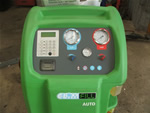
Air Conditioning Service & Re-Gas from only £45.00 + VAT
To keep your system operating at optimum efficiency, it needs to be serviced at least once a year
How the system works
If you compress a gas it becomes hot, but when you let it expand again it cools down. If you turn a gas into a liquid, and then allow it to turn back into a gas the effect is multiplied. The main components of all systems are as follows.
The gas is drawn into the compressor, and then compressed by a number of pistons. The compressed gas then goes through a large radiator normally behind the normal cooling rad, where the gas is cooled. This piece of equipment is called the condensor because it condenses the gas (turns it from a gas to a liquid.) The liquid gas now moves into the car, and is squirted through a jet into another radiator. The gas evaporates and cools down. This radiator is called the evaporator for obvious reasons. Basically that is all there is to it. Provided the system doesn’t develop a leak, the gas will continue this cycle, almost ad-infinitum. Everything else in the system is designed to control temperature or to ensure a longer life for the equipment.
Gas
A number of gases will work very well, however only two have been deemed as suitable for use on motor vehicles. They rejoice in the imaginative names of R12 and R134A.
R12 is no longer produced, and since the 1st of January 2001 it has been illegal for us to use it in air con systems. This is not a problem until the system needs some maintenance, at that stage the customer has the choice of either having the vehicle converted to use R134a, or opening the window. All cars manufactured since 1994 have used R134A. The reason for this is that R12 is a CFC which means that it does not break down in the atmosphere, and contributes to the destruction of the ozone layer. Indeed it is illegal to vent this gas , the maximum fine being £20,000. It is unfortunately the case that the two gases are incompatible, and where R12 was fairly benign to rubber seals etc, R134a has a tendency to destroy them, and certain types of hose. So changing from one to the other can be a bit of a problem. The process of converting a system to run on R134a is known as "retro-fitting".
Retro-fitting
If your car was registered before 1994 there is a very good chance that it had a gas called R12 in it's air conditioning system.
Because R12 is a C.F.C. it has the ability to damage the Earth's ozone layer. Because of this production was banned in the early 1990's, and after 1993 all new cars had to run on the replacement gas called R134a. This causes considerably less damage to the environment, and as air conditioning systems tend to leak, it was a reasonable move to make.
There were still considerable stocks of R12 however, and for a number of years it was permitted to re-charge systems with this old gas. However the European Commission issued an edict that told us that from 1st January 2000 this would be illegal.
Unfortunately it is not possible to put R134a into the older systems without carrying out some work first. This is because the new gas will react with the oil, and residues from the old gas causing a number of problems. This leaves the customer with two choices which are detailed now.
1) Fit a "drop-in" replacement gas. These are alternative gases which are purported not to cause reaction problems, yet still perform properly. They are used by a number of companies with reasonable success. The advantage that these gases have over a full retro-fit process is the cost. For only slightly more than a normal re-gas the system can be running again. The down side is that if and when the system needs charging again it will need to be with a company that uses the same gas, because as there is not a standard drop-in replacement, it is very possible to end up mixing a number of different gases over time.
We always carry out a full gas analysis prior to recovering any gas into our equipment, however if a vehicle is found to have a non-standard gas we will refuse to work on the system, because recovering the gas would pollute our stock, and we have no way of knowing if other modifications have been carried out to the system
2) Retro-fit is an expensive option, but it is recognised as industry best practice. The reason for this is simply that you are able to apply known standards to the work being carried out, and when the system needs work in the future, other repairers will know what to expect.
TO BOOK AN AIR CONDITIONING SERVICE & RE-GAS
CALL (01736) 75 56 84
|